LIKE BUTTON

Sunday, June 10, 2012

A 101 on the two giants (Gift for AVIATION GEEKS)


How to know your Airbus from Boeing 

Many of us admire airplanes for the graceful, elegant and sleek flying machines that they are.
How many of you have wondered about the type or kind of the aircraft that you are traveling in or flying over you in the sky? Is it a Boeing or an Airbus? Is it an A330 or a B777?


Here’s a simple aircraft identification guide for those with a budding interest in aviation. I’ll try to make this post as visual as possible since plane-spotting works best by observing as many different types of aircraft as possible and drawing your own inferences. Now sit back, relax and enjoy this journey!
How to know your plane?


First and the easy way out, look for the name of the aircraft type to be written on the aircraft fuselage. Most airlines still retain it. This should be easy if you are closer to the aircraft parked on the apron.
Now for the second part. For practical purposes, we will focus only on the big 2 giants of aviation – Airbus and Boeing, and close the gates on Lockheed, McDonnell Douglas, Antonov, Ilyushin, Bombardier, Embraer, Sukhoi etc.
We will also only consider airplanes that are currently flying around the world in large numbers, which means no clearance for 707 or 727 to take off.


A quick 101 on the two giants:


Boeing is American and the largest global aircraft manufacturer by revenue, orders and deliveries. Airbus is European and a subsidiary of EADS, and manufactures half of the world’s jetliners.
Boeing aircraft start with the #7 series. You have 737, 747, 757, 767, 777 and the new 787 Dreamliner along with the 747-8 Intercontinental currently under development.
Airbus aircraft start with the #3 series. So you have A300, A310, A318, A319, A320, A321, A330, A340, A380 and the A350 currently under development.

Airbus or Boeing – A-Team vs. B-Team

          Airbus nose – Bulbous, curved.

                   Boeing nose – pointed.

Check out the noses. Boeing will have more pointed noses while Airbus will have bulbous, curved noses.
Check out the cockpit windows. Airbus cockpit side windows run in a straight line along the bottom, whereas most Boeing side windows run in a ‘V’ shape along the bottom. Also Airbus aircraft cockpit side windows look like one of their corners have been ‘cut’.

                        Airbus A330 APU area – circular.

                        Boeing B777 APU area – sawed off.

Have a look at the APU Exhaust unit beneath the tail. Both Airbuses and Boeings have a circular outlet with the only exception with B777  having a sawed off unit.
All Airbus wide-bodies apart from the 380 have a fuselage top that continues straight all the way to the APU exhaust. Boeings have a taper downwards. The end of Boeings are ‘tapered’ and slope on the top and bottom, whereas on Airbus the top is straight and the bottom is very sloped.

Narrow-body or Wide-body


The shorter and smaller planes are called narrow-bodies, as they have a single aisle.
Airbus: A318, A319, A320 and A321.
Boeing: B737 and B757.
The longer and larger planes are also called wide-bodies, as they have twin aisles.
Airbus: A300, A310, A330, A340, A380 and A350.
Boeing: B747, B757, B767, B777, B787 Dreamliner and B747-8 Intercontinental.


2 engines or 4 engines


Only A340s, A380s and B747s have four engines. All other aircraft have twin engines.


The big ones – B747 or A340 or A380

                        If it has two decks of windows and four engines, it is an A380.

                        If it has one and half decks and four engines, it is a B747.

                        If has a single deck, longer fuselage and four engines, it is an A340.

The intermediates – B777 or A330


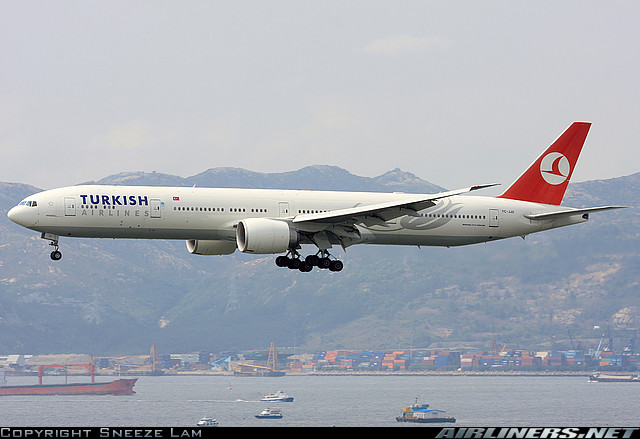
Check out the 3 pairs of wheels on each main landing gear of the above B777.
A B777 will never have a winglet.
The B777 has 14 wheels in a 6 6 2 configuration. The ever-helpful Sandy Ward  from Future of Flight has this great tip to identify Boeing 777s – 3 sevens have 3 wheels.
Ed Kaplanian from Future of Flight has more tips to differentiate between A330s and B777s.

The A330 with 2 pairs of wheels on each main landing gear.
Wheels: The main landing gear on an A330 has two sets of wheels, what they call in the industry (a two wheel truck). The main landing gear on a B777 has three sets of wheels, what they call in the industry (a three wheel truck).

                     B777 with sawed-off APU.


A330 with conical APU.

Tail end: The APU (auxiliary power unit) exhaust outlet is mounted in the middle of the tail cone on an A330. The APU (auxiliary power unit) exhaust outlet is mounted on the left side of the tail cone on the B777.
Wing tips: The A330 wing incorporates small wing tips on the wings. The B777 wing does not have wing tips.

The small birds – A320s vs. B737s
In terms of capacity, this how the Airbus airplanes in the A320 family compete with the Boeing 737 family.
A318 vs. B737-600
A319 vs. B737-700
A320 vs. B737-800
A321 vs. B737-900


The B737-700 is on the left and the A320 is on the right. Note how the tail fin of the B737 rises from the main body at a sharp angle.


The A320 is at top and the B737 is at the bottom. The 320 fuselage is rounded at the front, pointed at the back. The 737 fuselage is pointed at the front, rounded at the back.


Can you guess who is A320 and B737 in the above pic?
In each case, the Boeing version is lighter and seats more people. The Airbus version sits higher off the ground compared to Boeing. The A320s have fly-by-wire technology, which means the computer plays a larger role in flying the plane while pilot has the final say in flying a Boeing 737. A320s are longer compared to B737s but have lesser range.
Look at the tail fin to know your 737 from A320. If the tail fin rises from the main body at a sharp angle, it is a B737.
If it is larger, has rounder engines and a longer fuselage, it is an A320.
If it has a flatter engine at the base, it is a B737.


Boeing Focus:


Know your B737s
The B737s come in 9 versions: -100, -200, -300, -400, -500, -600, -700, -800, and –900ER. The –300, -400 and -500 fall into the category of Classics while the last 4 are New Generation Boeings. The –300s are the shortest while the –900ER is the longest. The only exception to the rule is –400, which is longer than the –300, -600 and –700 versions.


                        B737-100 – classic.


                   B737-200 – classic.


                   B737-300 – classic.


                   B737-400 – classic.


                   B737-500 – classic.


                   B737-600 – new generation.


                   B737-700 – new generation.


                  B737-800 – new generation


                  B737-900 – new generation

The –100 and –200 have cigar shaped nacelles. The –100s are out of service.
If the front of the engine nacelle is flattened and has an almost triangular shape, it is a Classic.
If the front of the engine nacelle is almost round-shaped, it is a New Generation 737.
If you can look at the APU exhaust at the tail and spot 2 holes, it is an NG. If it has a single hole, it is a Classic.
Also, all Classics have eyebrow windows.
If it is a stubby looking Classic, it is a 500. If it is a stubby looking NG, it is a 600.
If it looks “normally” proportioned and it is a Classic, it is a 300. If it looks normally proportioned and it is an NG, it is a 700.
If it looks long and it is a Classic, it is a 400. If it looks long and it is an NG, it is an 800.
If it looks really long and has 3 doors on each side, it is a 900.
If you are checking out a B737 belonging to Oman Air, flydubai, Jet Airways or Air India Express it will be a –700 or –800.

Know your B747s
B747s come in five versions – 100, -SP, -200, -300, and -400. All versions are 70.6m long except the B747SP from the -100 family which is around 15m shorter. There are a few sub-variants but we will primarily focus on the big 5.


The B747-100 & -200 have ten windows on each side of the upper deck. Some of the first -100s off the production line have only 3 windows on each side of the upper deck.


The B747-200 has ten windows on each side of the upper deck.


The B747-300 has an extended upper flight deck compared to the -200 and -100. It also has a door on the upper deck between windows.


Only the B747-400 has wingtip extensions or winglets.


The B747-SP fuselage is shorter than all other B747 variants but compensates for it with a taller tail.

Know your B757s
B757s come in two versions – 200 and the longer –300. The drooping dolphin shaped nose and thin, swept back wings of this aircraft type is a distinct giveaway.


The –200 comes with 3 doors on each side with a smaller emergency exit window.


The –300 comes with 4 doors and 2 over-the-wing emergency exit windows on each side.


Know your B767s
The B767 comes in 3 variants – 200, –300 and –400 with respective Extended Range versions. The –200 is the shortest while –400 is the longest.


                        The B767-200

                        The B767-300


                        The B767-400
What are the key differences between a B757 and a B767?
The Boeing 767 wingspan is 48 metres, 10 metres greater than the B757. The position of the nose wheel relative to the flight deck is much further forward on the 767 than on the 757.
Also, the main landing gear is a long way back on the B767.


Know your B777s
The easiest way to identify a B777 is to look at its tail area for a blade-shaped tail cone. Also check out the main landing gear. If you spot 6 wheels on each landing gear, it is a 777. There are 4 passenger versions of the 777: B777-200, B777-200 ER (Extended Range), B777-200LR (Longer Range), B777-300 and B777-300ER (Extended Range). These variants are distinguished on the basis of their fuselage length and nautical range. The –300s are longer than –200s by over 10m.
Fuselage lengths:


B777-200 – 63.7m
B777-200ER – 63.7m
B777-200LR – 63.7m – the world’s longest-range commercial airliner. Boeing named this aircraft the Worldliner, highlighting its ability to connect almost any two airports in the world.


B777-300 – 73.9m
B777-300ER – 73.9m

Airbus Focus:
Know your A300s
The A300 B2

                       The A300 B4

                       The A300 -600

The A300 comes in 4 main variants – the B1, B2, B4 and the -600. The A300-600 is a later version of the earlier A300B4 and features a wingtip that is shaped like a triangle above and below the end of each wing.


The A300 vs. A330
The basic fuselage design of the A330 is derived from the A300. So how do you differentiate between the two aircrafts when they are parked next to each other? The A330 comes with winglets and is longer than the A300. (A winglet is a wingtip extension that extends UPWARD from the end of the wing). The A300 may or may not have a wingtip. Also, the A330 has a larger wingspan (the distance in a straight line from one wingtip to other).


The A310


The A310 is basically a baby A300. It comes in two main variants: -200 and -300. It has a shorter fuselage, a new, higher aspect ratio wing, smaller tail when compared to the A300. Also, the A310 has only two doors on each side, whereas the A300s have 3 doors on each side.


Know your A320s
The A320 family of jets includes the A318-100, A319-100, A320-200 and the A321-200.
In terms of fuselage length, the A318 is the shortest (aka Baby Bus) and the A321 is the longest.
                        A318-100 – 31.44m

                       A319-100 – 33.84m

                        A320-200 – 37.57m

                       A321-200 – 44.51m

The A320 will usually have two emergency window exits over the wings whereas the A318 and A319 have only one emergency window exit over the wing. The A321 will have four exit doors on each side.

Know your A330s
The A330 comes in 2 passenger versions – the A330-200 and A330-300. The –300 version is longer than the –200 version but has a shorter tail height. The –300 carries more passengers but has a shorter range. Also, note the 4 wheels on each main landing gear and the smoother curvature of the tail to distinguish it from a B777.
Fuselage lengths:
                        A330-200 – 58.8m

                        A330-300 – 63.6m

Know your A340s
If it is single deck and has got 4 engines, you bet it is the A340. The A340 comes in 4 passenger versions – the A340-200, A340-300, A340-500 and A340-600.
The fuselage lengths should help you distinguish between them. The A340-600 is the second longest airplane in the world after the B747-8 Intercontinental, currently under development. Both the –500 and –600 come in High Gross Weight (HGW) Versions, with enhanced range, fuel capacity, weight amongst other features.
Fuselage lengths:
                        A340-200 – 59.39m

                       A340-300 – 63.60m

                        A340-500 – 67.90m

                       A340-600 – 75.30m


"When once you have tasted flight, you will forever walk the earth with your eyes turned skyward, for there you have been, and there you will always long to return."

Sunday, June 3, 2012

COMPETING BEAUTIES IN THE SKY (A380 VS B747-8)


The world’s largest jetliner, Airbus A380, has dominated the skies since its introduction in 2007. Now it has a contender. Boeing’s recent innovation, the 747-8 Intercontinental, is in direct competition with the massive A380. Both craft sit at the top of their class, feature similar characteristics, and compete for a dominant share of the same passenger market.But which is better? Both planes attracted quite a buzz when they were first unveiled, but who reigns supreme? The following comparison reveals the hard facts behind the “face-off of the year” in the aviation community.

Capacity 

 In typical 3-class configuration the A380 can seat nearly 530 passengers. The 747-8 certainly scores slightly lower at only 467 passengers. However, the numbers of passengers on a certain airplane can vary depending on seat configuration requirements of a particular airline.
Another factor to consider: a few more seats aren’t always a draw to airlines looking to purchase a new craft. “With an A380, you run the risk of not filling every seat whenever you fly,” remarked Boeing deputy program manager Elizabeth Lund, during the premiere of the 747-8 last month.Since its introduction, however, the popularity of the jumbo Airbus among airlines has remained strong. According to Airbus, as of Feb. 2011, the total orders amount to 244, with 44 craft currently in operation.Since it was only recently unveiled, orders for the new 747-8 are just beginning: Korean Air, Cathay Pacific, and Lufthansa are the fist to place orders for the plane.

Size 

The Freight version of the 747-8 is the only airplane of jumbo freight airliners, after Airbus suspends its A380 freight version in 2007. (Courtesy of Boeing Corporation)

In terms of overall length, the 747-8 bests the A830. At over 250 feet, the 747-8 is currently the longest commercial airplane in the skies—about 13 feet longer than the A380.

But the A380 still remains the world’s tallest aircraft at almost 80 feet. The 747-8 is just shy of 64 feet.The Airbus 380 may not be the longest, but it still carries more passengers. In the end, it all comes down to choosing a model that fits the needs of a particular airline. Customer orders will show if Boeing got it right again.

Price

Engine choice, design weights, and level of selected customization by airlines are some of the options that factor into the price of a plane.
The Boeing 747-8 is priced at just over $317 million, while the Airbus 380 costs considerably more—$375 million. Airbus increased its catalog price nearly 8.4 percent at the beginning of the year.If airlines are to choose between the A380 and the 747-8 due to cost alone, the decision is simple—for every five Airbus craft purchased, a customer can buy six of the Boeing.

Speed and Range

According to Airbus tech specifications, the 380 can fly at a maximum cruising speed of Mach 0.89. The 747-8, meanwhile, only offers a maximum speed of Mach 0.86. Of course, as passengers, we feel little of the speed when flying.The range of the A380 shows it can travel over 9500 miles in a single trip, while the 747-8 will not fly much beyond 9200 miles.The world definitely looks much smaller nowadays when taking a trip from New York to Hong Kong, from LA to Mumbai, or from London to Singapore—trips that these crafts are capable of.

Fuel Economy

With rising fuel prices, and low-budget airlines on the rise to meet travelers’ demands, of significant concern is how much fuel a plane will burn to take a large number of passengers from point A to point B.Both planes are designed with innovative ideas to meet real economic concerns. These formidable craft incorporate features such as new wing designs, improved engines, and lighter materials to achieve the best possible fuel efficiency based on number of seats and distance traveled.“The 747-8 has the lowest operating costs of any airplane in its class; the lowest trip cost; the lowest cost per seat mile; and the lowest fuel burn per seat mile,” explained Jim Proulx, Boeing Commercial Airplanes Communications.On its website, Boeing offers a host of reasons why their craft trumps the Airbus. Compared to the A380, the 747-8 claims to be 10 percent lighter per seat and it burns 11 percent less fuel per passenger.So what does Airbus say? Unfortunately, Airbus press offices both in Europe and the U.S. could not be reached about the comparative fuel efficiency of the competing craft.But the showdown between the A380 and 747-8 is far form over. In a WSJ online article from Feb. 13th, an Airbus executive claims that the 747-8 has yet to pass evacuation tests.“Boeing will meet or surpass every requirement for passenger evacuation,” countered Boeing’s Proulx.According to Proulx, “about one third of the market that Boeing sees for very large airplanes (400 seats and up) over the next 20 years is for freighter airplanes.”In early 2007, Airbus made an announcement suspending the development of the A380 freight version, and as Boeing claims, “it was too heavy and inefficient, meaning that the 747-8 is the only airplane in that market.” 


Sunday, May 27, 2012

Boeing vs. Airbus: The Pilot Weighs In


Is one more fun to fly? Is one model safer than the other? Plus: How they measure up in the looks department


The worldwide fleet is split roughly 50/50 between Boeing models and Airbus models. (Boeing, as most people know, is a U.S. product, while Airbus is a European consortium headquartered in France.) It’s true there are significant differences between the two, in their operating philosophies and basic systems architecture. But how, exactly, they are different, and what this means to the pilot, is something that would take many boring pages to answer — and even then would be confusing to the layperson. Trust me, the typical reader doesn’t need me to go there, and it’s better to avoid trying to explain this nitty-gritty altogether rather than risk a cartoonish comparison similar to the one that Palmer provides. His explanations were pretty simplistic.
Contrary to what a lot of people think, there aren’t two “camps” of pilot out there, with one that swears by the Boeing camp and another loyal to Airbus. Sure, a pilot might prefer one over the other, but it’s probably just a case of whatever he or she is used to. And as I’ve discussed in the past, seniority determines virtually everything in a pilot’s life, including which aircraft he or she gets to fly. Most pilots bid their preferences based on which assignments are the highest-paying, together with various quality-of-life issues — what will give me the best schedule, the best commuting options and so on. Whether it’s a Boeing or an Airbus is really secondary.
I’m often asked if pilots consider one model “better” or “safer” than the other. The long answer to this question would require nuanced comparisons between autoflight systems, fly-by-wire technology and the like — once again, for most of you, a wholly boring conversation. The short and perfectly acceptable answer is no. Both planes have their own pleasant or annoying idiosyncrasies, and although there might be some merit to the argument that Airbus relies too heavily on automation — under certain conditions, Airbus flight control software precludes manual inputs from the crew entirely — we’ll eventually wind up at a statistical stalemate. In conventional wisdom, Airbus is the more “controversial” player, but both plane-makers have endured scandals and controversies, from the air data sensor malfunction that may have played a role in the 2009 Air France disaster (Airbus), to the rudder design problems that caused at least two fatal 737 crashes (Boeing).
“If it’s not a Boeing, I’m not going,” reads a sticker you’ll sometimes see on pilots’ flight cases or on the bumpers of their cars. It’s a cute rhyme, but don’t read too much into this.
A Boeing is a Boeing; an Airbus is an Airbus … but not. Even those aircraft within the same “family” can be vastly different from one another. Pilots transitioning from model to model, be it from an A320 to an A330, or from a 737 to a 747, will undergo a full training course, usually lasting several weeks. The only exceptions for this are the Airbus A330 and A340, and Boeing’s 757 and 767, which allow for simultaneous dual qualification. Yours truly is a 757/767 first officer. I might fly a 757 from New York to Los Angeles, then a 767 on the return.
A common question is whether planes “feel” or “handle” differently from one another. They do. Seldom will you find two aircraft types with identical flying characteristics. A 757 “feels” quite different from a 767, for instance, even as the two are otherwise so similar that they share a common certification. The former is heavy and somewhat sluggish on the controls; the latter, even at double the size, is much lighter and more sensitive.
But how important is this? The hands-on controlling of an aircraft is only a small part of what goes into “flying” — along with navigating, systems managing, communicating, etc. Thus you don’t compare airplanes the way you compare cars.
Handling and performance are only part of the criteria. You’d be surprised how often simple ergonomics and comfort are cited for the reasons that a pilot likes or dislikes a particular model. For example, one of my big reasons for disliking the ATR was because the air-conditioning system was so weak. 
My memory is balky when it comes to how fast these planes went, how high they flew, or how powerful their engines were. But I remember how they smelled, how they sounded, and how the rest of their intangibles otherwise excited me — or failed to.


"When once you have tasted flight, you will forever walk the earth with your eyes turned skyward, for there you have been, and there you will always long to return."

Saturday, February 25, 2012

LOST BIRD (Story Of STOLEN AMBITION- obscured by thick dust layers)


Once, a girl was born in the big, dignified family of 11 members. Respect is the only necessity of the family. Birth of a she child called for a reason for a grand jubilation. Everyone was in high spirits as if they had won all the happiness of life. Baby girl must be the luckiest one. She is the first child in the family. She got everything she wanted in the childhood. She dreamt of something, she used to get it the other day. Every one treated her like a princess. Excessive care, attention and love made her adamant. Each and every time listening to what she is saying, what she wants; fulfilling all her stupid little desires. They have never let her see the outer world. How dirty the world is, she simply can’t believe this fact. She was living in her own world of fantasy where she had all kinds of luxury and materialistic happiness.

On completion of her higher school she told her parents that her ambition is to become a white collar officer i.e. an Indian Air Force pilot. Her parents took that as one of her other stupid desires. But she was damn confident and stubborn to become the flying officer. When she entered in the 11th grade, because of heredity she developed a need of spectacles. So she dropped the idea to become the IAF pilot. But flying planes was her biggest desire since the time she used to travel in the wide body airliner to spend her summer vacations. Sitting at the window seat with wide open eyes watching the wing changing its shape, filled her with curiosity equalizing the Maximum Take Off Weight. After clearing senior secondary exams, she revealed again that she want to be an aviator. But this time she wanted to be a commercial pilot. This brought a thunderstorm in the family.

Girl revolted, screamed, wept, starved and finally was gifted with the grand present i.e. the family’s permission to take up flying as her career. Girl started to fly airbus in her dreams from that day itself. After rigorous flying training of 8 months, clearing 5 written commercial pilot license (CPL) exams in one go and off course spending a handsome amount on flying lessons, she finally achieved CPL. Now again after gaining CPL she started dreaming of flying airbus, this time more clearly and strongly as now she has become legally eligible to fly one. As and when she got the license, Indian aviation industry got hit by recession. But nothing could stop her world of fantasy from growing. She waited for 2 long years.

And then gradually realized that there is no such value of her in the family. No one actually wanted her to become a pilot. No one is worried about her career. Her morning started with taunts and her days ended with curses. Her mother regretted that why they permitted her to go for CPL and spent a hell lot of money. Now when the girl demands for something which can give her piece of delight like new clothes, new handbags, new accessories or new shoe wear, they tell her that they have already spent so much on her so they can’t take her expenses said by a person having an empire of crores makes no sense to me. Does regular taunting can solve her problems? Cursing her that why she opted to be a pilot and burned their hard earned money with no results can help her in any way? Killing the ray of hope and discouraging her at every point. Will all this help this girl? She is imprisoned in the golden empire where no one can hear her silent sobbing, where no one can see her watery eyes, her hidden tears, where no one can feel her internal fear.

She tried to gain confidence by doing something that can bring her fame and return back her lost confidence. She joined online radio station and earned a little bit of fame. Everyone in the family was satisfied about it as it is an ONLINE radio where she can work sitting at home. She has to stop working as radio was becoming a hindrance in her aviation studies. So she quit radio to be back on her flight track. She then decided to write poetry regarding what flying a plane means to her. When in an excited tone, she told her mother that she writes poetry expecting a ray of pride on her face, mother’s expression and words of discouragement i.e. “what is the use of writing? You can’t earn out of it?” literally was a slap on her face. But she continued writing. After being mentally tortured on daily basis she is still rigid like a rock that she’ll be a pilot one fine day.

Once she got a job offer from Corporate Airlines. She was so happy and thought that this is the end of the journey to success. Alas! Again her life took a U- turn when her family didn’t allow her to work for corporate stating that they want her to work for commercial airlines only. Again this makes no sense to me. She roared, cried and pleaded but no one in the family supported her for the same. Then she decided to take classes (as a teacher) on aviation subjects so that she can grow her knowledge. When she told her family she wanted to take classes, what they said “For that she’ll have to travel a lot.” The place where she’ll be taking her classes is far off from her place. Making a girl a pilot and worried about travelling a long distance again made no sense to me at all.  How can they be such hypocrites! She wants to hangout and sometimes party with friends so that she can release her stress but her parents never allow her to move out of her home stating, “Outside world is not safe.” Haha once again this is senseless. Care and imprisonment are two different things which I think they are unaware of.

Now tell me do her parents really want her to become a pilot or they are just making a fool out of her? Do they really love, care and understand her? Are they not selfish? Are they doing justice to her? Are they killing her ambition? Are they making use of her innocence?

And what should a girl do? Should she elope from her home? Should she keep watching what is happening with her, silently? Should she stop hoping? Should she wait for her second phase of life, i.e. marriage? Should she kill herself? Should she accept the failure? Should she regret that why she sat in aircraft even once?

Moral-   Wealth can’t give you all happiness in life. Family support is the biggest pillar of one’s life. Parents should support their children when needed otherwise they can lose them. All that glitters is not gold.


"When once you have tasted flight, you will forever walk the earth with your eyes turned skyward, for there you have been, and there you will always long to return."